A large repair quote can make replacement feel obvious. A new-truck price can make repair feel equally obvious. Neither number settles the decision on its own.
The useful comparison is what each option will cost and deliver over the same future period. Include the truck’s condition, its suitability for the job, the time it will be unavailable, and the requirements of the replacement. Money spent keeping the old truck running last year is evidence about its history, not a reason you must keep spending.
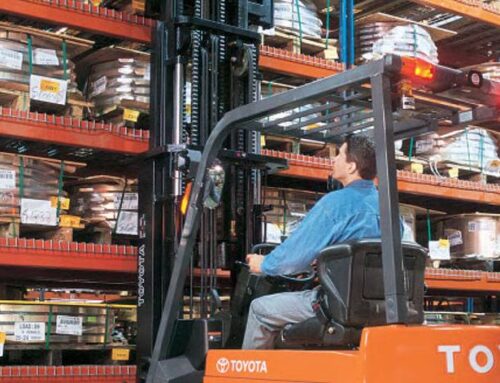
Photo: Toyota Material Handling. Manufacturer technician imagery.
First establish whether repair restores a suitable truck
Ask a qualified technician what the proposed repair addresses and what remains uncertain. Is the estimate limited to the identified fault? Are there other known concerns, or further inspection findings that could change the scope? Request a written explanation you can compare with the service history.
Keep safety and equipment suitability separate from the budget debate. California’s industrial truck rules require unsafe equipment to be kept out of service until made safe. A pending purchasing decision does not change that obligation.
Then check the job itself. Have loads, lift heights, attachments, surfaces, or operating hours changed? Restoring a truck mechanically does not establish that it is the right equipment for a different application. Have the proposed configuration evaluated against the actual work.
Read the history as a pattern
Collect repair invoices, service reports, hour readings, and interruption records. Separate a one-time event from repeated faults. Ask which findings are related and which are independent; a spreadsheet of invoice totals cannot make that diagnosis.
Toyota’s replacement guidance distinguishes useful life from economic life and notes that there is no universal economic-life standard because use and environment differ. That is why a birthday or hour-meter reading alone is an unreliable replacement rule.
Record the consequence of each interruption too. A truck used occasionally may be easier to cover than the only truck capable of a critical handling task. Low hours do not automatically mean low business importance.
Compare options over one horizon
Choose a period that makes sense for your operation, such as the next budget year or the expected duration of a contract. Use that same period for every option. Have finance select a consistent cash-flow or ownership-cost method; do not mix a full purchase price on one side with only a few months of costs on the other.
| Decision input | Repair and retain | Replace or change the arrangement |
|---|---|---|
| Initial work | Confirmed repair scope, related work, and uncertainty | Acquisition terms, delivery, setup, and trade-in/disposal treatment |
| Operating support | Expected maintenance, energy, and parts support | Maintenance terms, energy infrastructure, and required support |
| Availability | Repair timing and temporary coverage | Delivery timing and coverage until ready |
| Job fit | Verified suitability after repair | Verified suitability of proposed truck and attachments |
| People and facility | Any changed procedures | Operator preparation, access, charging/fueling, and other setup |
| End of period | Remaining condition/value assumptions | Remaining value or end-of-contract obligations |
List assumptions beside the figures. A technician may be able to identify likely future work, but nobody should label an uncertain forecast as a guaranteed repair bill.
Test the uncertainty that could change the answer
Compare a reasonable expected case with a less favorable case. If the repair scope expands, would retaining the truck still make sense? If replacement delivery takes longer, what temporary coverage is needed? If the workload falls after the current project, would a long-term equipment commitment still fit?
You do not need a complicated model to see which unknown matters. Mark the one or two assumptions that change your decision and get better information about those first.
Ask what the repaired truck would let your team accomplish next season. A repair-to-purchase-price ratio cannot tell you whether its mast will reach the planned rack levels or whether it can cover the required shifts. Include those application requirements in the comparison.
Include an alternative to a like-for-like purchase
Replacement may mean a different equipment type, a suitable used truck, or a temporary rental while the longer-term need becomes clearer. Those are options to evaluate, not shortcuts around fit or condition checks.
Watts offers new and used forklift equipment and rental options. Ask for comparable proposals using the same load, route, shift, and timing requirements. A lower price is not comparable if the proposed truck cannot perform the required task.
Make the decision reviewable
Finish with a short decision record: the truck and job, the options considered, the comparison period, the confirmed costs, the significant uncertainties, and why the chosen option fits. Name the next action and the person responsible.
For a repair assessment, contact Watts’ service department at 209-825-1700 with the model, serial number, current hours, and service history. A clear repair scope and an application review give you a much stronger basis for deciding than either quote viewed alone.