A pallet arriving at the dock may need three different kinds of handling before its contents leave the warehouse: a move across the floor, placement into storage, and picking for a customer order. Calling all three jobs “forklift work” can hide useful differences.
The Crown range includes equipment for each of those tasks. Start by identifying which part of the process you want to improve, then compare the relevant families. This guide will help you build that shortlist without assuming every warehouse needs the same truck.
Watts Equipment is a Crown-authorized sales, parts, and service provider. Bring the task and the load details when discussing a model; the family name is the beginning of the selection process.
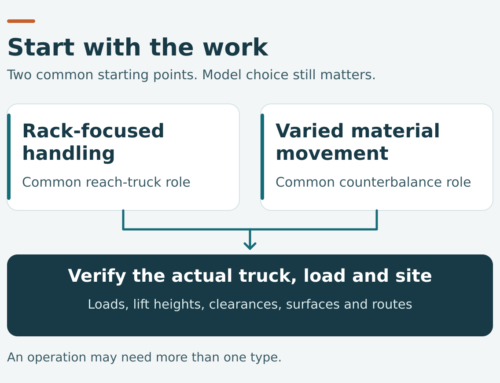
Floor-level movement points toward pallet trucks
If the task is moving palletized goods between work areas without placing them into elevated storage, discuss a pallet truck. Crown’s pallet-truck range includes manual, walkie electric, and rider equipment. Examples include the PTH manual family and powered walkie and rider families for different applications.
The useful distinction is the work pattern. Record the distance traveled, number of moves, load and pallet details, and where the operator needs to stop. Then compare an appropriate manual or powered option. Do not select solely because the load is below an advertised capacity.
If the same task also involves elevated storage, describe that explicitly. A low-lift pallet truck is not a substitute for equipment designed to place a pallet into a rack. Separating transport from storage may make sense, but it should be a deliberate process decision.
General handling may call for a counterbalance truck
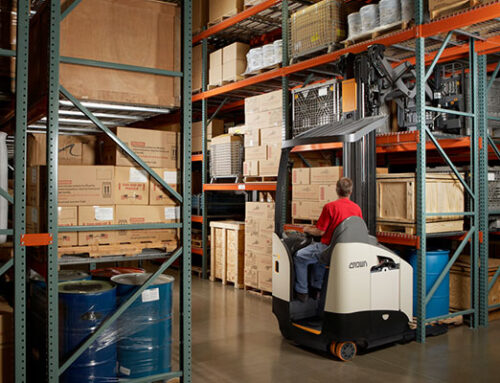
Receiving, replenishment, and transport can overlap in a single shift. Crown’s RC stand-up counterbalance series is presented for tasks including dock work, transport, and retrieval or replenishment in aisles.
That makes it a family to discuss when one truck must serve several areas. It does not mean it fits every dock or rack layout. Include trailer access, mast clearance, pallet dimensions, floor conditions, and operator workflow in the review.
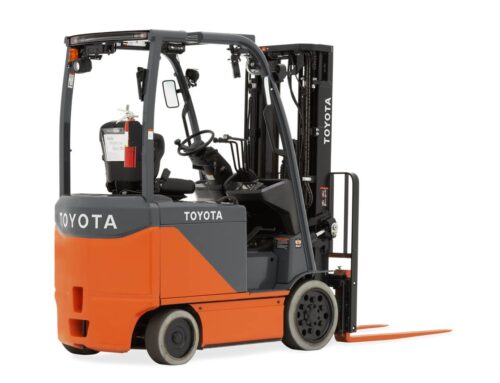
Other Crown counterbalance families include sit-down electric and internal combustion equipment. If the job includes outdoor travel or different surface conditions, bring that requirement into the comparison rather than treating all counterbalance trucks as interchangeable.
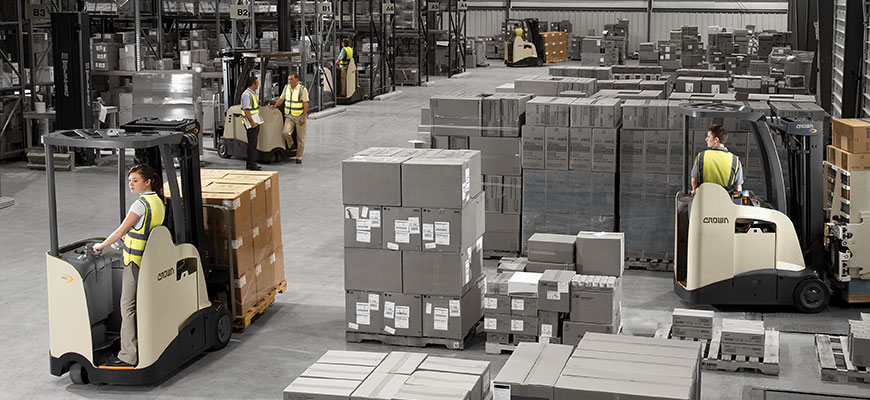
Crown manufacturer application photo; not a Watts customer or facility.
Rack placement brings reach-truck choices into focus
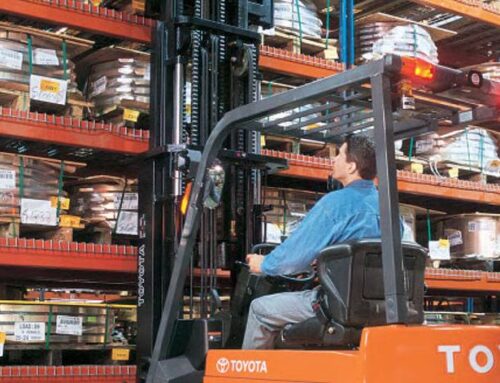
Crown’s reach-truck families include RR/RD, RM/RMD, and ESR equipment for rack-storage applications. The shortlist should follow the storage arrangement and handling task.
One distinction is particularly worth clarifying: single versus double reach. Crown describes the RD 5700 as having deep-reach forks for pallets positioned two deep. That capability needs to match the proposed rack system and loads; it is not a reason to assume that any reach truck will serve double-deep storage.
Ask the equipment provider to evaluate the complete movement at the intended storage height. Include load geometry, capacity in the proposed configuration, aisle working clearance, and access to the rack. Use the actual application, not a comparison of maximum brochure lift heights, to narrow the choice.
Picking items is different from moving a full pallet
When the job is retrieving individual items or cases from elevated storage, discuss order-picking equipment. Crown’s SP 1500 is a high-level order-picker family with operator-compartment and control options.
Bring the picking method into the conversation: what the operator handles, how orders are organized, and what tools or supplies must be within reach. Review the task and operator requirements with the supplier and your responsible safety team, including training and the equipment’s prescribed protection requirements.
A truck that moves pallets into storage and a truck that positions an operator for picking solve different problems. If your order mix is changing, make sure the proposed equipment follows the new work rather than the old label for it.
Compare two tasks before trying to solve everything with one truck
Consider a hypothetical operation where one counterbalance truck spends the morning unloading and the afternoon moving pallets between workstations. It may be a suitable arrangement. But if both tasks regularly need the truck at once, the question becomes whether the process needs another resource, a different equipment mix, or a scheduling change.
Use this short brief when talking with Watts:
The main task is ___. A typical load is ___. The busiest period is ___. The truck also needs to ___. The place where the current process breaks down is ___.
Ask which Crown family fits that main task, which configuration is proposed, and which secondary tasks still require review. Have the quote identify the truck, mast, attachments, power equipment, and relevant options.
You can explore Crown equipment through Watts and discuss service support alongside the purchase. A useful recommendation should explain why the equipment fits the work, not simply which model is available.