The repair invoice answers what it cost to fix the truck. It does not show what happened while the truck was unavailable: people waiting, work moved to overtime, or a replacement rental brought in to protect a shipment.
You can estimate that impact without using an industry-average dollars-per-hour claim. Start with one interruption and separate the costs you actually incurred from lost capacity and uncertain future consequences. A useful estimate should be understandable to someone who was not there.
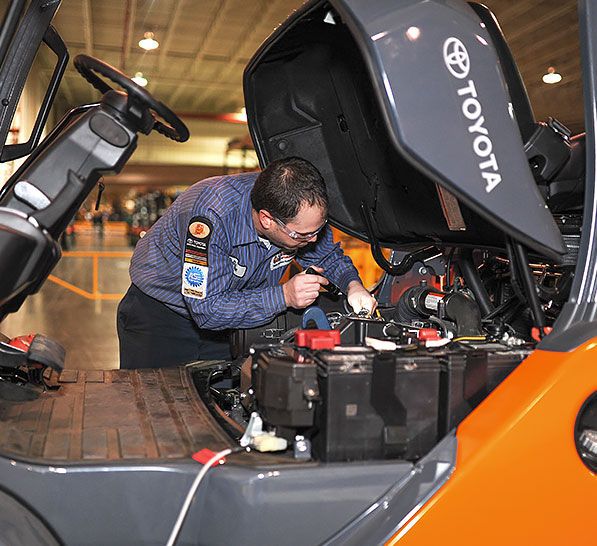
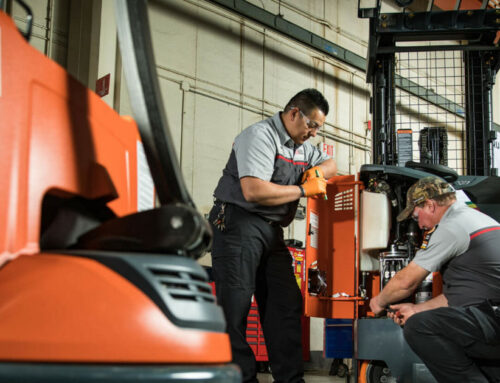
Photo: Toyota Material Handling. Manufacturer service imagery.
Define the event before counting costs
Record when the truck became unavailable, when the affected operation resumed, and when the truck returned to service. These may be three different times. A suitable rental could restore work before the original repair is complete.
Name the activity that was interrupted. “Truck unavailable for eight hours” does not necessarily mean eight hours of production lost. Another truck may have covered the task, staff may have moved to useful work, or only part of the shift may have been affected.
Also record the recovery decision: waited for repair, reassigned equipment, rented a replacement, or changed the work schedule. That gives the numbers context.
Keep three categories separate
Direct repair cost includes the actual repair charges attributable to the event. Record warranty or other credits separately so the net amount is clear.
Additional recovery spending includes costs that would not otherwise have occurred: rental and delivery, additional freight, incremental overtime, or documented fees. Use invoices or approved estimates rather than assumed penalties.
Lost productive capacity can include paid time during which affected staff could not perform other useful work. This is an economic estimate, not necessarily an extra payroll payment. Label it separately from additional cash spending.
Lost sales require another distinction. A delayed order that eventually ships is not automatically lost revenue. If a sale is genuinely lost, have the finance team determine the appropriate lost contribution after avoided costs; do not simply add the order’s full selling price to every other expense.
A worked example with hypothetical numbers
Suppose a forklift interruption prevents three employees from doing useful work for two hours. The team later recovers the schedule with a rental and additional overtime. The following figures are invented solely to demonstrate the method; they are not Watts rates or industry averages.
| Item | Assumption and calculation | Amount |
|---|---|---|
| Repair | Invoice net of applicable credits | $600 |
| Replacement rental and transport | Additional event-specific charges | $350 |
| Additional recovery overtime | 4 labor-hours × $45/hour incremental fully loaded cost | $180 |
| Idle labor capacity | 3 employees × 2 hours × $30/hour loaded regular cost | $180 |
Additional repair and recovery spending: $1,130. Add the separately identified idle labor capacity estimate of $180 for a combined event-impact estimate of $1,310 under these assumptions.
The example assumes the four overtime labor-hours were additional paid hours, so their full incremental cost is included. If the same hours would have been worked anyway and only a premium changed, count only the extra cost. It also assumes the six idle labor-hours produced no other useful work. Reduce that estimate if people were productively reassigned.
There is no lost-sale amount in this example because the work was recovered. Counting lost sales as well would require a different, supported assumption.
Copy this event worksheet
For your next review, fill in:
- Event date, equipment ID, affected task, and cause if confirmed.
- Equipment-unavailable hours and operation-interrupted hours separately.
- Net repair charges and the evidence behind them.
- Additional rental, transport, overtime, freight, and other event charges.
- Idle labor-hours after subtracting productive reassignment.
- Any genuinely lost contribution, with finance’s calculation and overlap checks.
- Recovery choice and what would have happened without it.
Mark each input as actual, quoted, or estimated. A rough but clearly labeled estimate is more useful than a precise-looking total built on guesses.
Use the result to improve the next decision
Compare recovery options using the costs still ahead of you. Money already spent diagnosing the fault should not be added again to one option simply because it is visible.
For example, a replacement rental might add a direct charge but reduce further idle time or overtime. Compare those changes over the same period and confirm equipment suitability and availability before assuming the rental restores full output.
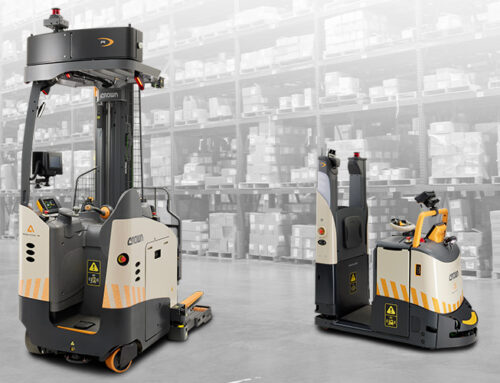
Keep a consistent event record across the fleet. Crown’s fleet-management information describes tracking maintenance history and costs alongside operational data. You can begin with a spreadsheet; the essential step is defining the measures consistently.
Watts provides forklift service and rental options. When you call 209-825-1700, explain which task is stopped and what replacement capability would be needed. That helps turn a repair conversation into a practical recovery discussion without pretending every hour of downtime has the same value.