A forklift tire decision starts with the truck and the surface it works on. The replacement must suit the equipment’s approved configuration and the application. A tire that looks similar—or has more tread—is not automatically the right choice.
If the immediate concern is damage or wear, have the condition assessed before ordering. A different tire will not necessarily solve the underlying reason a truck is wearing tires unevenly or struggling along its route.
Know which tire construction you are discussing
Toyota’s tire selection guide distinguishes cushion, solid pneumatic, and air-filled pneumatic tires. The names can be confusing: a pneumatic-style tire may be solid rather than air-filled.
| Tire type | Construction and common application | What to confirm |
|---|---|---|
| Cushion | Solid rubber pressed onto the wheel; commonly used on trucks working on smooth indoor floors | Approved size, truck configuration, load, and route |
| Solid pneumatic | Solid rubber in a pneumatic-style tire; used in suitable indoor/outdoor applications where puncture exposure matters | Approved fit and suitability for the actual surface and conditions |
| Air-filled pneumatic | Air-filled construction with a specified inflation pressure; used on suitable trucks for outdoor and uneven-surface applications | Approved specification, pressure, puncture exposure, and site suitability |
Treat this as a conversation guide, not a conversion chart. Start with the truck’s specifications and ask which options are approved. Do not assume that changing tires converts a warehouse truck into equipment suitable for soft ground, slopes, or an outdoor yard.
Describe the complete route. An operation that mostly uses smooth concrete may still cross a damaged threshold or outdoor section. Include those details rather than labeling the application simply “indoor.”
Look beyond tread depth
A forklift tire can need attention even when there is visible tread. Toyota’s tire replacement guidance identifies chunking, tearing, flat spots, and wear reaching an applicable wear line as concerns. Its guidance also calls attention to uneven wear and damaged rims.
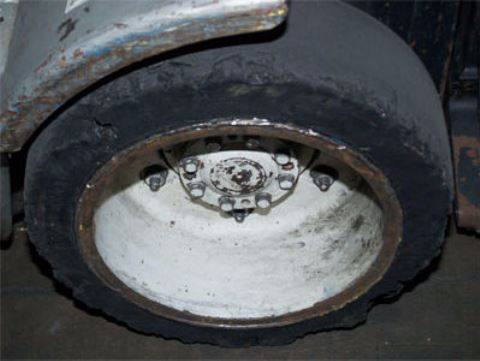
Photo: Toyota Material Handling. An example of tire damage; use the applicable manufacturer’s criteria to assess your equipment.
Not every tire uses the same visible wear marker. Ask the provider to identify the replacement limit for the actual tire rather than applying an internet measurement to every design. For air-filled tires, use the manufacturer’s specified pressure; that instruction does not apply to solid constructions.
Report new vibration, unusual ride behavior, or uneven wear along with the visible condition. These observations help a technician decide what needs examination. They do not, by themselves, establish a diagnosis.
Make the report useful
When a tire concern is found, record which truck and which tire are involved. Include the make, model, serial number, tire size and markings if safely visible, and a photo showing both the damaged area and the tire’s position on the truck.
Add the operating conditions: surfaces, debris, transitions, load-handling tasks, and any recent change in the route. Explain whether the concern appeared suddenly or has been getting worse.
California’s industrial truck rules require beginning-of-shift checks, including attention to tires. Unsafe equipment must be reported immediately and kept out of service until made safe. Do not wait for the next scheduled maintenance visit to report an unsafe condition.
A photo is a useful record, but it is not a substitute for an assessment where one is needed. Do not crawl beneath equipment, remove wheels, or attempt pressing or mounting work to obtain better information. Tire and wheel work should be handled by qualified personnel using appropriate procedures and equipment.
Ask why the damage occurred
Replacing a worn tire addresses the part. Reviewing the operating conditions may reveal a repeat problem that deserves attention too.
Ask the service provider whether the wear pattern suggests a need to inspect the truck, confirm the tire specification, or review the route. Walk the area with the person responsible for the facility and note broken surfaces or debris for correction. Keep that review separate from assigning blame to an operator without evidence.
For example, if a tire is repeatedly damaged near the same doorway, record the location and ask for the transition to be assessed. The observation is useful even before the cause is known. Document any corrective action alongside the replacement so the next review can show whether the issue returned.
Prepare the replacement request
Before approving a quote, confirm the tire specification, application suitability, installation arrangement, and expected equipment downtime. Ask whether other tires or wheel components need assessment and how the technician will determine the scope. Avoid choosing a replacement solely from a photograph or the lowest line-item price.
Watts Equipment provides forklift parts support across makes and forklift service. Call 209-825-1700 with the equipment identifiers and the concern you have observed. The right starting question is “What is appropriate for this truck and this condition?”